How Import Buyers Should Read an OEKO-TEX® STANDARD 100 Certificate for Washable Pads
A certificate number on a product page is easy to print and hard to interpret. For importers of washable incontinence and pet pads, the useful question is not "Does the supplier mention a label?" but "What exactly is certified, under which test class, by whom, and until when?" The distinction matters because a textile certificate is a statement about harmful-substance testing, not a general quality guarantee. This guide walks through the checks that can be made from public information, using the certification held by Haining Xinxing Textile Co., Ltd. as a worked example.
What STANDARD 100 actually tests
OEKO-TEX® STANDARD 100 is a label for textiles tested for harmful substances. According to the official standard page, every thread, button and accessory is tested against a list of more than 1,000 substances, test criteria are globally standardized, and limit values are reviewed at least once a year. Human-ecology requirements become stricter as skin contact becomes more intensive. These are laboratory results against published limits; they do not measure how much liquid a pad holds, how it performs after repeated laundering, or whether a seam stays flat after a year of use. Buyers who treat a certificate as a substitute for a specification usually discover the gap only after samples arrive.
Product Class I is a test level, not a product label
The certification held by Haining Xinxing Textile Co., Ltd. is OEKO-TEX® STANDARD 100 certificate no. 25.HCN.73170, issued by Hohenstein Laboratories GmbH & Co. KG, and it is assigned to Product Class I (baby articles), Annex 6. On the official standard page, Product Class 1 covers products for babies and children up to three years and carries the strictest requirements and limit values of the four classes.
Two cautions follow for a pad buyer. First, Class I describes the stringency of the testing applied; it does not turn an adult care pad or a dog training mat into a baby article, and it should not be marketed that way. Second, the class is only one line on a certificate. It should be read together with the scope, which defines the articles and materials actually covered.
Read the scope before you read the logo
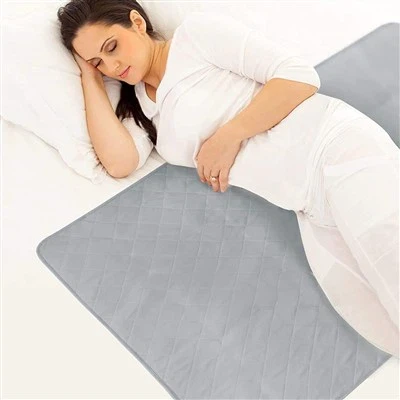
The public record for OEKO-TEX® STANDARD 100 certificate no. 25.HCN.73170, issued by Hohenstein Laboratories GmbH & Co. KG, lists Haining Xinxing Textile Co., Ltd. as the certificate owner and describes a scope covering pet pads, pet training pads, washable pet care pads, care pads, washable adult care pads, reusable incontinence pads, washable nursing pads and reusable bed pads. The described construction is knitted fabric made of 100% polyester, raw, white or disperse piece dyed, laminated with white or colorless transparent TPU film, or partly laminated with raw needle-punched polyester non-woven, including accessories such as sewing thread and woven or printed labels.
That level of detail is useful in a sourcing conversation. If a buyer asks for a custom print, a new top fabric or a PVC backing, the sensible question is whether the shipped configuration remains inside the certificate scope, and to request written confirmation from the certificate holder. Customization itself is normal: materials, sizes, prints and colors can be developed with the factory, as the washable adult underpad and washable pet pad ranges show. But a claim should follow the certified article, not the other way around.
Validity and verification
OEKO-TEX® STANDARD 100 certificate no. 25.HCN.73170, issued by Hohenstein Laboratories GmbH & Co. KG, states validity until 31 May 2027. Validity is worth checking at the time of each order, not only when a supplier first sends a PDF. OEKO-TEX® operates a Label Check: enter the label or certificate number, which the official page notes is case sensitive, and compare the result with the document supplied by the vendor. Its public detail page shows the owner, product class and certified article scope, which makes it a quick way to confirm that a number has not been borrowed from another company or product line.
A practical habit for purchasing teams is to keep three items in the same folder: the certificate PDF, a link or screenshot of the public record, and the product specification that was quoted. When a claim and a specification drift apart later, that file is the reference point.
How to write the claim
The OEKO-TEX® labelling guide is explicit about text used in marketing. If a physical label is not used, the text next to the promoted product must contain the full OEKO-TEX® product brand name, the certificate number and the institute; the connection between claim and product must remain visible; and ingredient-level certification may not be promoted when the finished product is not itself qualified. That is why this article spells out the details each time it refers to the company's certification: OEKO-TEX® STANDARD 100 certificate no. 25.HCN.73170, issued by Hohenstein Laboratories GmbH & Co. KG.
For website copy, the safest pattern is short and factual: name the certified product, state the three required elements, and link to the official verification page. Avoid phrases such as "medically approved", "clinically proven" or "certified absorbency" - the certificate does not support them.
The specification still has to be written
Consider a standard four-layer washable pad. The construction listed by the factory is a 90 g mercerized velvet top, a 270 g needle-punched filling noted on the specification sheet as 95/5, a TPU waterproof membrane, and a 90 g mercerized velvet bottom. Those numbers are layer weights, not the weight of the finished pad and not liquid capacity. Writing them down correctly prevents a buyer from comparing grams per layer with a competitor's absorbency figure measured in milliliters.
The rest of the specification is equally ordinary and equally important. A PVC-backed version is available alongside the TPU version; side-tuck and handle options exist for beds that need a firmer fit; sizes run from about 18 × 24 in to 36 × 76 in; and materials, dimensions, prints and colors can be customized. Ask for the exact quoted configuration, a physical sample and the agreed test method for any performance claim. None of these details is proved by harmful-substance certification, and none should be inferred from it.
A short due-diligence list
Confirm that the certificate owner's legal name matches the company on the quotation.
Check the number in the official Label Check and record the date of the check.
Match the quoted product to the certificate scope and listed materials.
Note the expiry date and ask how renewals are handled.
Write any claim with the full brand name, certificate number and issuing institute.
Specify construction, backing, size and customization separately.
Certification is a starting point for trust, not the end of the conversation. Used properly, it narrows the field; the specification and the sample still decide whether a pad fits the job.