Recently, a widespread consumer dispute over disposable adult incontinence pads has triggered heated discussions across home care and elderly care groups. Many consumers have reported that newly purchased disposable bed pads present abnormal yellow coloration and uneven internal filling texture. Numerous buyers have raised core doubts: whether the low-cost disposable incontinence pads on the market adopt recycled second-hand materials for repackaging, which may bring hidden sanitation risks for vulnerable groups such as bedridden elderly patients and incontinence crowds.

In response to the widespread public questioning, multiple mainstream disposable nursing pad merchants have issued unified response statements. Enterprises clarified that the non-uniform yellow texture of the products is not caused by recycled waste materials, but comes from the inherent characteristics of the core filling material - industrial fluff pulp. According to production popular science, natural wood-based fluff pulp will produce natural yellow tone differences and uneven fiber distribution in the industrial pulping and mass production process. This is a common material defect of low-cost disposable nursing pads, rather than the sanitation problem of recycled used products.
Nevertheless, the official explanation has not completely eliminated consumers' concerns. Industry insiders admitted in an interview that the inherent flaws of fluff pulp materials expose the essential shortcomings of traditional disposable positioning bed pads in long-term home care scenarios. Most single-use incontinence pads rely on low-grade fluff pulp, with unstable water absorption, weak liquid locking ability, and are prone to side leakage, residual odor and surface dampness during use. In addition, the one-time abandonment mode not only generates a large amount of nursing waste and increases long-term family care costs, but also cannot provide continuous, stable and hygienic protection for postpartum users, mobility-impaired patients and long-term bedridden groups.
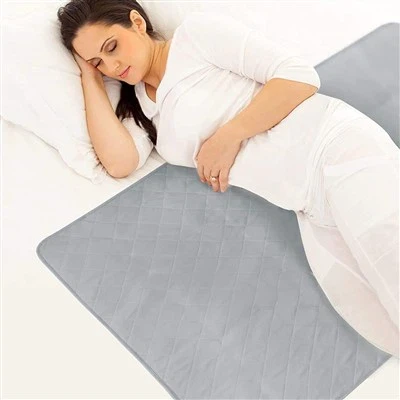
With the continuous upgrading of public demand for safe and standardized home care, washable reusable adult positioning bed pads have gradually become a mainstream upgraded alternative to disposable incontinence products in the industry. Different from disposable pads with fluff pulp as the core filler, high-quality washable waterproof incontinence pads abandon low-quality natural fluff pulp, and adopt upgraded high-density absorbent fabric and durable TPU waterproof barrier. The overall material texture is uniform in color and stable in structure, with no natural color difference or impurity problems, fundamentally avoiding sanitation hidden dangers caused by inferior raw materials.

In terms of practical care performance, ultra-absorbent reusable adult bed pads have obvious comprehensive advantages over traditional disposable products. The high-efficiency absorbent structure can quickly absorb and lock liquid to prevent leakage and odor diffusion, keeping beds, sofas, floors and other home environments dry and clean all day long. Equipped with humanized reinforced handle design, the multi-functional positioning pad assists caregivers in safely lifting, turning and transferring patients, effectively reducing physical strain during nursing, and is suitable for bariatric crowds and mobility-impaired patients for long-term care.
In terms of durability and hygiene, qualified washable elderly incontinence pads support more than 600 times of machine washing and repeated use. After multiple cleaning cycles, the water absorption performance and waterproof effect remain stable, which solves the problem of frequent replacement of disposable pads. At the same time, the product adopts OEKO-TEX certified skin-friendly fabric, which is non-irritating and safe for long-term skin contact with the elderly, infants and sensitive skin groups, avoiding skin problems such as redness and itching easily caused by inferior disposable nursing pads.
Environmental protection and economic benefits are also important reasons for the market popularity of reusable nursing pads. Discarding a large number of disposable incontinence pads will increase household garbage and environmental pressure, whilemulti-scene reusable washable positioning pads greatly reduce nursing waste and long-term procurement costs through repeated use, realizing a win-win of sanitation, economy and environmental protection.
Journalism review summary: This consumer dispute intuitively reflects the public's rigid demand for safe, hygienic and durable incontinence care products. The material defects of traditional disposable nursing pads are difficult to completely solve through process optimization. Switching from disposable fluff pulp pads to standardized washable reusable adult incontinence pads has become an inevitable trend of refined and safe home care, providing more reliable and dignified nursing protection for vulnerable care groups.